
The economic shockwaves from the Russian invasion of Ukraine continue to ripple through unexpected corners of the digital world even in 2026. When global sanctions first crippled the Russian economy four years ago, few predicted that a hardcore first-person shooter would become a bizarre financial barometer. Yet Escape from Tarkov, developed by St. Petersburg-based Battlestate Games, has seen its in-game ruble faithfully track the wreckage of its real-world counterpart—a trend that shows no sign of stabilizing.
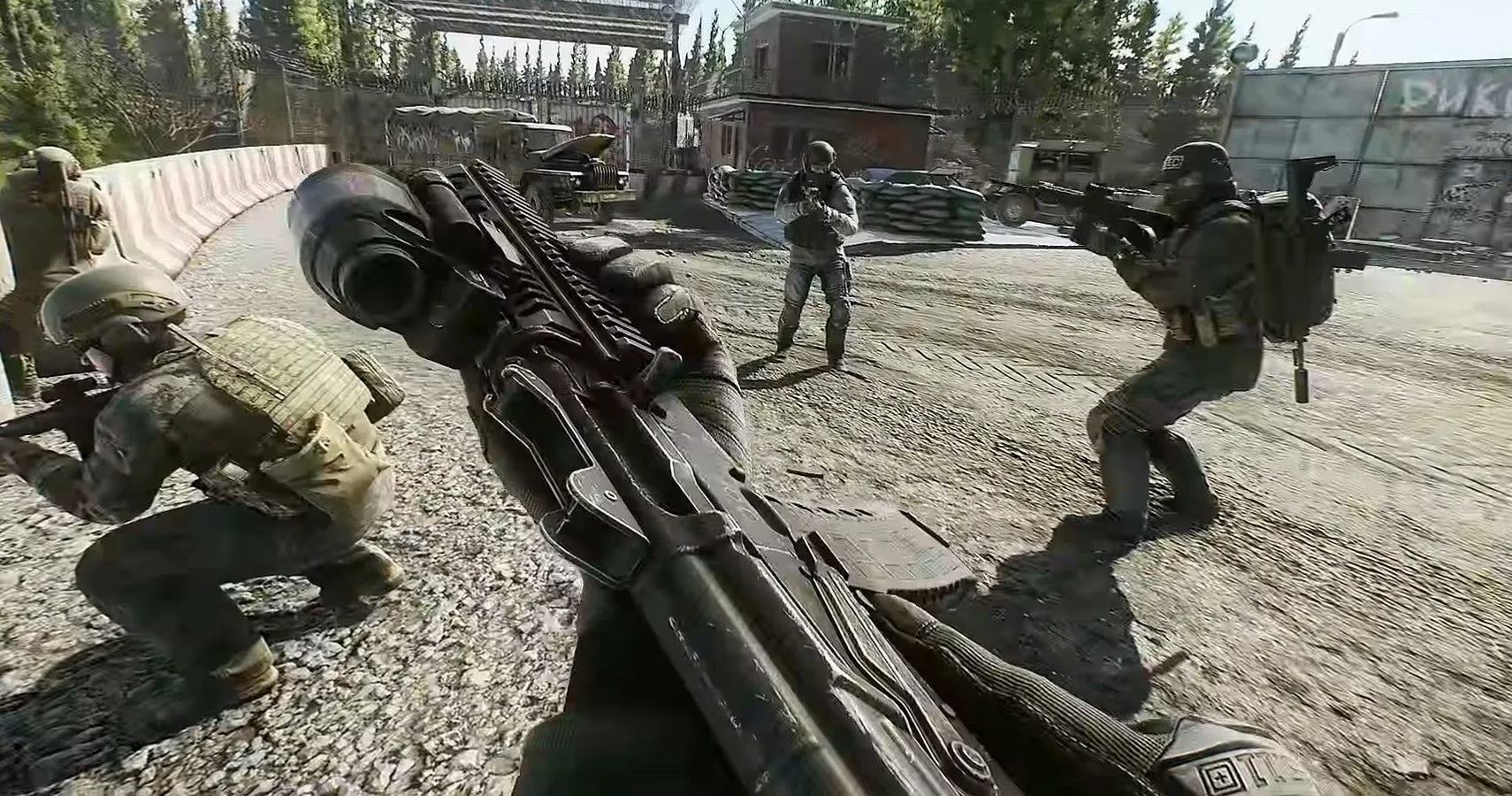
Escape from Tarkov drops players into the fictional Norvinsk region as military contractors. Survival demands mastery of a brutally complex in-game economy, where every bullet, backpack, and bit of barter goods can be sold or traded using virtual rubles, euros, dollars, and even Bitcoins. This granular marketplace long prided itself on reflecting realistic supply and demand. What the developers likely never intended was for the currency itself to become a mirror of geopolitical turmoil.
As the real Russian ruble entered a freefall following SWIFT disconnections, frozen central bank assets, and technology embargoes, the in-game version collapsed in near lockstep. By mid-2022, the virtual ruble had lost over 30% of its value—almost identical to the real-world depreciation. Today, in 2026, the virtual ruble remains chronically weak. Although the real currency has clawed back some ground through state interventions and alternative trade corridors, the game’s unregulated flea market still treats the ruble with deep distrust. Players overwhelmingly prefer to hoard euros and dollars, whose in-game exchange rates against the ruble have permanently divorced themselves from pre-war norms.
📊 A Snapshot of the Ongoing Currency War (2022–2026 trends)
| Item / Currency | Type | Value Shift Since Sanctions |
|---|---|---|
| AKS-74UB assault rifle | Ruble price | 🔻 -37% |
| AK-74M assault rifle | Ruble price | 🔻 -21% |
| Euro / Dollar | Exchange rate vs Ruble | 🔺 +52% on average |
| In-game Bitcoin | Ruble price | 🔺 +31% (volatile) |
The impact on player experience has been stark and enduring. Newcomers, or "hatchlings" in the community slang, find themselves priced out of essential mid-tier gear. A basic kit that once cost a few thousand rubles now demands a steep grind, forcing many to attempt risky low-gear runs to scrounge for foreign currency. This has widened the gap between casual players and hardcore veterans, who often operate massive Bitcoin farms hidden in their in-game hideouts.
Those hideout Bitcoin rigs became digital goldmines almost overnight when the ruble collapsed. Veteran players who invested early now wield enormous purchasing power, able to dictate flea market prices and lock out competition. This inequality persists into 2026, with many veteran player-run market cartels openly coordinating to manipulate scarce items like military-grade armor and high-tier ammunition. The social friction has become so pronounced that some player groups now role-play as "crypto oligarchs" in a grimly humorous nod to real-world parallels.
Battlestate Games has historically treated these market gyrations with a hands-off philosophy. The company addressed in-game Bitcoin volatility only once in 2021, when prices hit absurd heights, by tethering the virtual coin somewhat to its real-world counterpart. But the ruble crisis? Battlestate has let it ride. Through developer statements and patch notes, it is clear the studio views the player-driven economy as a living organism that should self-correct. So far, the only interventions have been minor tweaks to trader restock times and loot tables—never a direct currency peg. By 2026, the developers have actually leaned into the chaos, adding in-game news feeds that report on the "ongoing financial instability in the Norvinsk region" as a lore-friendly explanation for the volatile exchange rates.
The broader context remains grim. Russia remains cut off from major digital storefronts like Steam for direct payments, though Battlestate sells the game independently. YouTube and Twitch continue to restrict monetization for Russian content creators, and semiconductor sanctions still hamper the hardware that powers gaming rigs in the region. All of this indirectly fuels the in-game economy: fewer local players can easily buy euros or dollars with real money, so the supply of foreign currencies in Tarkov stays tight, keeping their virtual value elevated.
Interestingly, the persistent ruble weakness has spawned a new breed of "forex speculators" within the game. These players monitor real-world economic indicators—oil prices, central bank announcements, even wheat futures—to predict short-term movements in the virtual ruble. A Reddit thread from late 2025 famously documented a player who made a fortune by shorting rubles just before a real-world EU sanctions renewal vote, translating his political knowledge into a virtual arsenal. Such meta-gaming has turned Escape from Tarkov into an accidental finance simulator for some.
Looking ahead, there is no indication that the virtual ruble will decouple from reality. As long as the real-world Russian economy remains isolated and under pressure, the in-game currency will continue to limp along at a discount. Battlestate Games appears content to let this experiment run, perhaps seeing it as a unique selling point. For players, it means every session is not just a battle for survival but a lesson in geopolitics—one where a lost connection to reality can empty a wallet, virtual or otherwise.