
Back in the summer of 2022, I remember the servers going down for an agonizing five hours. The Escape From Tarkov maintenance window felt interminable, but the promise of the 0.12.12.30 patch kept my squad buzzing in Discord. We had heard the rumors: an expanded Lighthouse, new bosses, and—most tantalizing for us—a cooperative offline mode. I had purchased the Edge of Darkness edition largely for the early access and the stash space, but this update made that investment feel genuinely special.
As an ordinary player who had been through the wipes before, I braced for the fresh start. The moment the update went live, I dove back into the familiar chaos. One of the first things I noticed was how much smoother everything felt. AMD FidelityFX Super Resolution (FSR) had finally arrived. My ageing RX 580 suddenly had new life. I could push the graphics a notch higher and still keep a stable framerate on Customs while scanning for threats. The technology, an analog to DLSS but available for a wider range of GPUs, was a game-changer for someone who couldn’t afford the latest silicon.
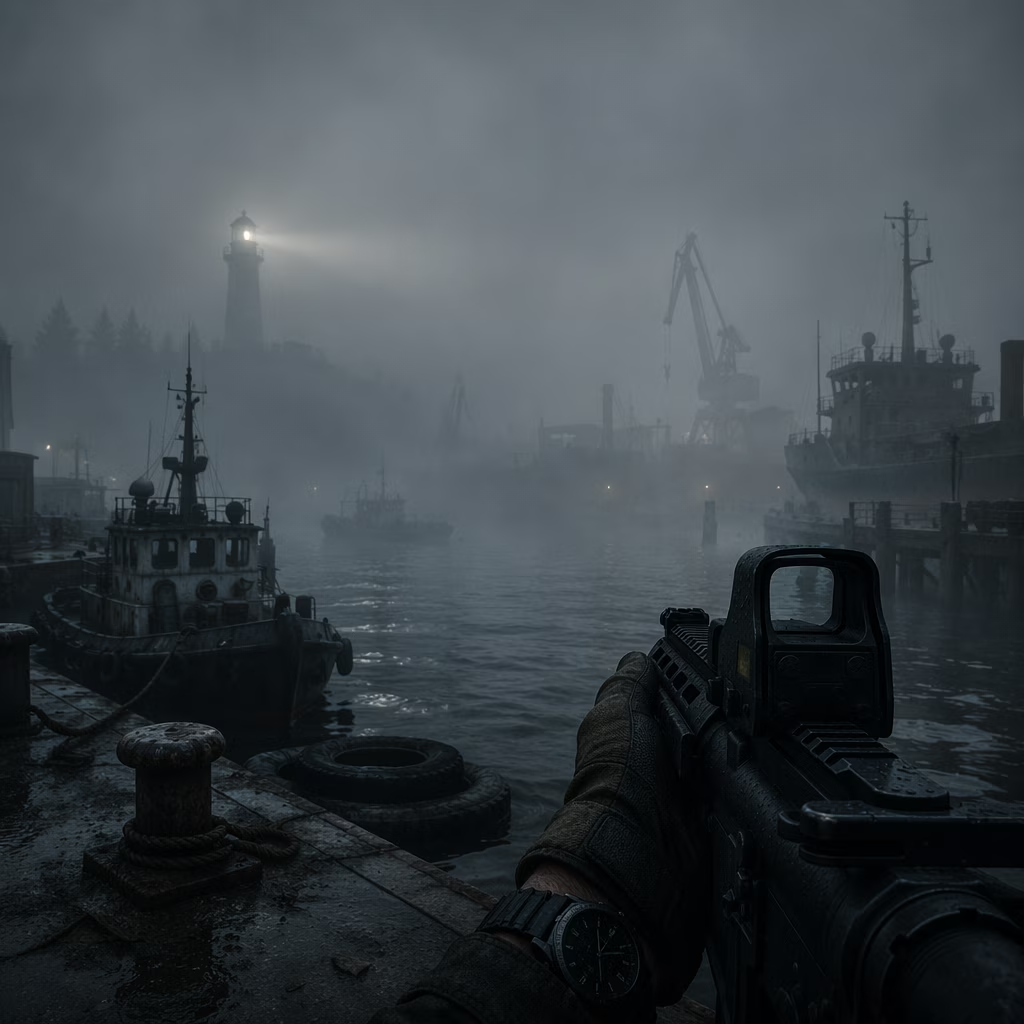
But the visual upgrades went deeper. The overhauled movement animations made my character feel like a real person instead of a floating camera with arms. Leaning during a sprint now tilted my body naturally, and the new breathing animations made every quiet moment in a bush feel tense and authentic. I still vividly recall the first time I swapped my rifle for a sidearm mid-sprint—the fluid weapon transition left me momentarily stunned. Even the soundscape had evolved. Boots scuffing on gravel, weapons clattering against concrete, and the heavy thud of a body slumping to the ground after a successful headshot—all of it pulled me deeper into the world.
The island on the Lighthouse map was the real star for me. Previously, that majestic lighthouse had been a distant postcard. Now I could actually cross the water, explore its rocky shores, and fight my way through the new interiors of the water treatment plant. It became my squad’s favorite spot for ambushes. But we quickly learned we weren't the only predators roaming.
Three new bosses—Knight, Birdeye, and Big Pipe—had entered the fray. These former USEC commanders, known as the Rogues, were unlike anything we had faced before. Knight, the assault specialist, would push you relentlessly. Birdeye would flank and snipe from impossible angles. And Big Pipe? That man loved his grenade launcher. I once watched him delete a five-man squad with a single salvo. Their coordinated AI was terrifying. When one spotted you, the radio chatter began instantly. Suddenly, Birdeye would pin you down from the treeline while Knight rushed your cover, and Big Pipe lobbed explosive hell from a distance. They didn’t stick together; they spread out, controlled territory like a professional fireteam. And they were hostile to everyone—USEC, BEAR, Scavs. No reputation mattered to them. If they had shifted to Woods, Customs, or Shoreline, our raid became a survival horror movie. We learned quickly that killing them didn’t tank your Fence rep, but surviving the encounter was the real reward.
One of the most controversial yet exciting additions was the offline cooperative mode. As an EoD owner, I could finally invite my friends into a private practice raid. No progress saved, no gear lost, just pure, stress-free tactical training. We used it to map out the new Lighthouse territories, test gun builds, and practice fighting the bosses without risking our hard-earned kits. The “Start as group” option let us spawn together in the center of a map, which turned co-op practice into a thrilling sandbox. The server load message—“Attention! High load on practice mode servers”—became a familiar sight during peak hours, but it never dampened our enthusiasm.
Scav life also got a meaningful shakeup. Fence started handing out daily tasks to Player Scavs, and I finally had a reason to build the Intelligence Center in my Hideout. Some tasks were straightforward scavenger hunts—find a collection of food items, medical supplies, or weapons in a single raid. It turned low-gear runs into tense, goal-oriented mini-games. I often found myself frantically checking every duffle bag and dead body to complete a grocery list before extraction.
The PMC inventory saw a long-overdue quality-of-life improvement: dedicated slots for special items. My compass, rangefinder, and wi-fi camera finally had designated homes that didn’t clutter my secure container. Best of all, these items couldn’t be looted from my corpse. That tiny detail saved my sanity more than once. The flare gun also arrived, allowing us to call in airdrops with red signal flares. The updated airdrop mechanics introduced four distinct container types—weapons, medicine, supplies, and general. Watching the plane swoop in with a countermeasure flare, then rushing to secure the drop before other players caught wind of it, became a heart-pounding routine.
The weapon sandbox expanded gloriously. The Benelli M3 Super 90 shotgun became my go-to for Factory runs. The Accuracy International AXMC sniper rifle let me roleplay a true marksman on Woods. And the RD-704 assault rifle? A terrifying beast in full auto. I spent hours in the Hideout tinkering with new crafting recipes and customizing the reworked SV-98. The attention to detail was staggering.
Some of the balance changes forced me to rethink my entire approach. The Perception skill now granted only a 0.3% hearing radius increase per level, capping at 15% instead of the old 35%. That meant you could no longer rely on superhuman hearing to detect enemies. The Elite Strength skill rework also changed the meta: weapons on sling, back, and holster became weightless, but all the ammo, grenades, and loot stashed in my rig and backpack still counted. I had to become smarter about my loadout. And the Elite Metabolism nerf meant that hitting zero hydration and energy still brought nausea and blur, even if you didn't take direct damage. No more running through the map like a dehydrated zombie without consequences.
Reflecting on that 0.12.12.30 patch in 2026, it’s clear it set a benchmark for Tarkov updates. It wasn’t just the content; it was the immersive coherence. The inertia tweaks, the reworked laser visibility (infrared lasers finally invisible to the naked eye but brilliant under NVGs), the wet asphalt effects on Lighthouse, and dozens of bug fixes polished the experience to a mirror sheen. I still remember the first time I saw a properly ragdolled body collapse and slide down a slope with the new physics.
Sure, there were hiccups—the temporary disabling of Mip Streaming, the occasional frozen airdrop container, and that one patch where my hands would get stuck visually. But BattleState Games nailed the overarching vision. They turned Tarkov into a living, breathing organism where bosses roam without schedule, where every raid can surprise you, and where the line between solo and cooperative play blurs beautifully. For me, that update was the moment Tarkov stopped being just a hardcore shooter and became a second home.